
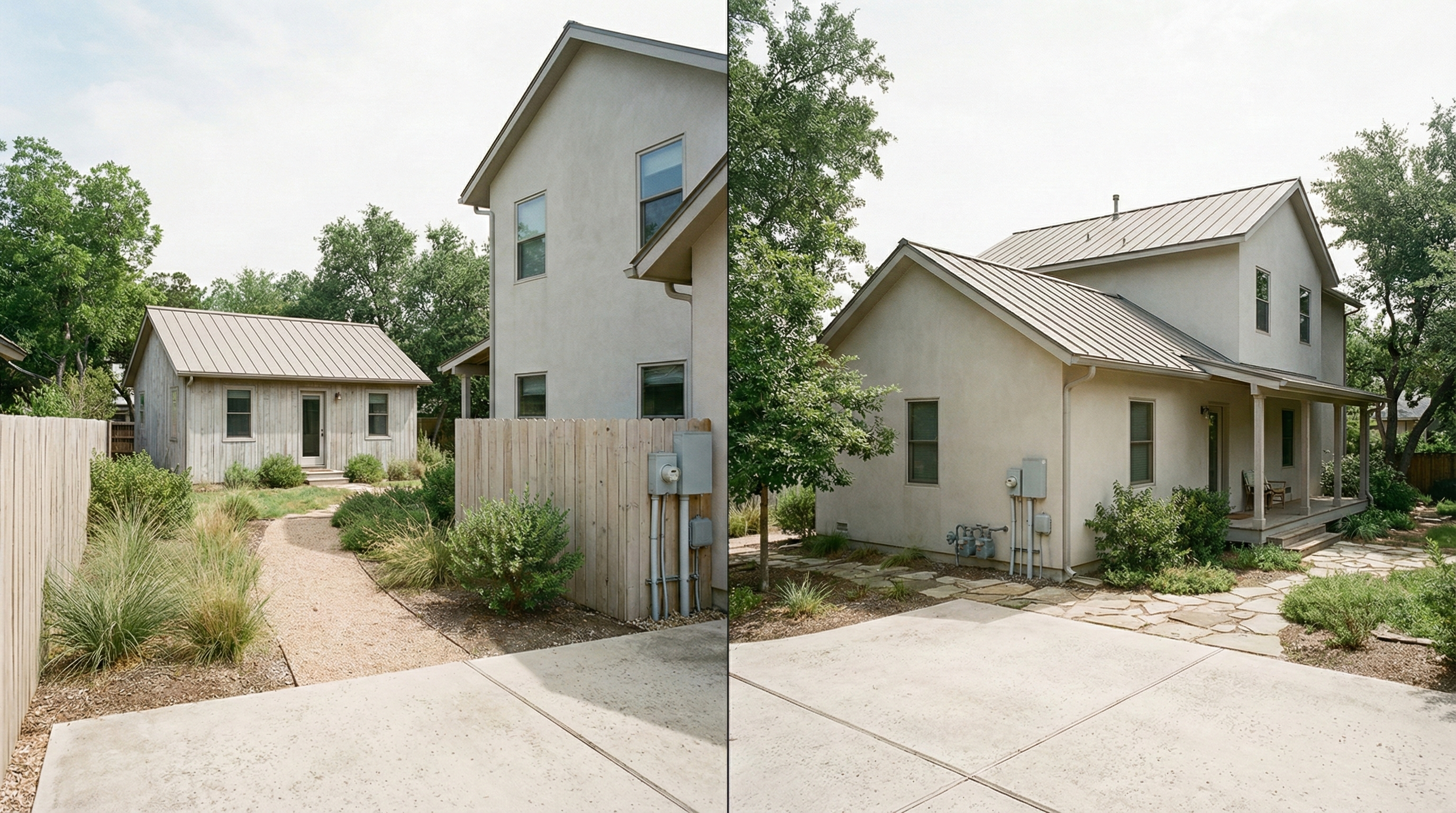
If you've been researching ways to add living space to your property, you've probably seen the terms ADU and DADU. Both let you create extra living space on your lot for rental income, housing family, or adding property value. Understanding what an accessory dwelling unit (ADU) is and how it's defined is the first step toward figuring out which type works best for your situation.
Key Takeaways
-
ADUs can be attached or detached from the main home, while DADUs are always separate standalone structures.
-
DADUs typically offer more privacy but come with higher construction costs than attached options.
-
Both must comply with local zoning regulations, setback requirements, and building codes.
-
Modular and prefabricated units can speed up construction time for either option.
-
Homeowners should research permit requirements in their area before committing to a project.
What Is an ADU?
An accessory dwelling unit is a secondary housing unit on the same lot as a primary residence. These units go by many names: granny flats, in-law suites, backyard cottages, or secondary suites. The defining characteristic is that it's a complete living space with its own kitchen, bathroom, and sleeping area, but shares the property with the main house. ADUs can be converted garages, basement apartments, or additions built onto the existing home.
Many families use ADUs to house aging parents who want independence while staying close. Others rent them out for income or use them as home offices. If you're curious about compact living, our all about tiny homes resource covers how smaller footprints can still deliver comfortable spaces.
What Is a DADU?
A DADU, or detached accessory dwelling unit, stands completely separate from the main house. Unlike attached ADUs that share a wall or roof with the primary residence, DADUs are independent structures built elsewhere on the property. You can learn about the definition of a detached accessory dwelling unit (DADU) and how it differs from attached options to get a clearer picture.
DADUs offer separation that attached units can't match. Because they're freestanding, occupants enjoy more privacy and less noise from the main home. This makes DADUs appealing for rentals where tenants expect independence. The trade-off is higher costs and additional considerations for utility connections, foundation work, and setback compliance.
Best DADUs By Home Nation
Jet

Constructed directly on your land with durable wood-frame construction, the Jet is built to meet strict building codes nationwide. Its efficient design makes it easy to maintain, energy-friendly, and long-lasting—perfect for those seeking both value and simplicity.
Island

Unlike manufactured housing, this DADU is site-built using traditional wood-frame construction directly on your land. Every home is engineered and built to meet the Miami-Dade County Hurricane Building Code, one of the strictest in the nation. That means you can feel secure knowing your home is designed to withstand high winds and severe weather conditions common in Florida and coastal regions.
Related: Guide to a Used Mobile Home
ADU vs DADU: Quick Comparison
When deciding between these options, it helps to see the differences side by side. The table below highlights the main factors distinguishing ADUs from DADUs.
|
Feature |
ADU |
DADU |
|
Attached to main home |
Sometimes |
No |
|
Separate building |
Sometimes |
Yes |
|
Privacy |
Varies |
High |
|
Cost |
Lower to Moderate |
Higher |
|
Lot requirement |
Same lot |
Same lot |
Which One Works Better for Your Property?
The right choice depends on your property, budget, and goals. If yard space is limited or you want to minimize costs, an attached ADU might work better. Converting a garage, adding onto your home, or finishing a basement is often more affordable than building from scratch. These projects also tend to move faster through permitting since they modify an existing structure.
If privacy matters or you have enough land for a separate structure, a DADU could be worth the investment. Renters pay more for standalone units, which helps offset higher construction costs. For the complete explanation of a detached ADU and its design considerations, explore how placement and utility access affect your project scope.
Related: Mobile Home Park vs Private Land the Best Option for You
Why Modular Units Make Sense
Traditional stick-built construction isn't the only path to adding an ADU or DADU. Modular and prefabricated units have become popular because they cut build time dramatically. These units arrive with pre-built components, including electrical systems and framed walls, so crews can assemble them on-site much faster than building from the ground up. For homeowners wanting rental income quickly or needing housing for a family member soon, this speed matters.
Home Nation offers standalone modular units that work well as DADUs, with factory-direct pricing that keeps costs reasonable. While the company can guide you on permits, homeowners remain responsible for researching local zoning and obtaining approvals. Every municipality has different rules about setbacks, height limits, and design requirements, so check with your local planning department early. Our guide to different types of mobile homes breaks down the options if you're exploring prefabricated solutions.

Permits, Installation, and Getting Started
Before ordering any unit, understand what your local jurisdiction requires. Permit processes vary widely. Some areas have streamlined ADU approval, while others require extensive reviews and multiple inspections. Setback requirements dictate how far your unit must sit from property lines, and lot coverage rules limit how much land structures can occupy. Height restrictions may also affect design options, especially for two-story DADUs.
Once you've secured permits, installation comes next. Our mobile home installation guide covers site preparation, foundation options, and utility hookups that apply to modular ADU projects. Proper foundation work and connections for water, sewer, and electricity are non-negotiable. Working with experienced contractors who understand local codes and modular construction keeps projects on track.
Ready to explore your options? Browse Home Nation's affordable mobile and modular homes to find units that could work as standalone ADUs or DADUs on your property.
Final Thoughts
Choosing between an ADU and DADU comes down to property layout, budget, privacy needs, and long-term plans. Attached ADUs cost less and work when space is tight, while DADUs offer independence and potentially higher rental value. Modular construction can speed up the process and reduce costs compared to traditional methods. Do your homework on local regulations, get realistic quotes, and think about how you'll use the space. The right secondary unit can add significant value while solving housing needs for years to come.